DEVELOPMENT
How Uko Umoh Is Championing The ARISE Agenda in Etinan

By Happiness HENSHAW
“He who follows the path of a wise leader will not lose his way.” – John C. Maxwell
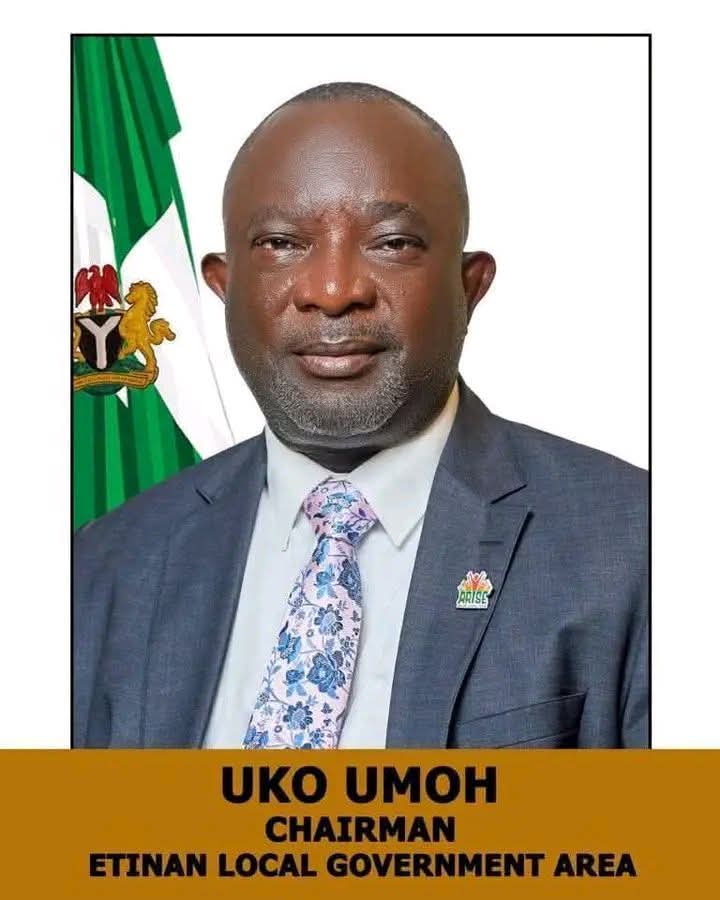
LEADERSHIP becomes truly meaningful when it is inspired by a vision greater than personal ambition. Across history, those who have left enduring legacies were men and women who understood that progress is sustained when tested ideas are faithfully translated into action. That appears to be the current story in Etinan Local Government Area, where the Executive Chairman, Hon. (Dr.) Uko Umoh, has deliberately aligned his administration with Governor Pastor Umo Eno’s ARISE Agenda, bringing its development philosophy to the grassroots with remarkable consistency.
In less than a year in office, Uko Biafra, as he is widely known by his Media friends, has steadily turned the ARISE Agenda from a state policy document into visible projects and measurable improvements across Etinan’s 64 gazetted villages. His administration reflects the same bottom-up development approach championed by Governor Umo Eno-one that places people at the centre of governance and ensures that no community is left behind.
At a time when many local government councils across the country have attracted public criticism over the management of increased allocations following financial autonomy, Etinan has charted a different course. Rather than becoming another example of squandered opportunities, the council has become a reference point for prudent management of public funds, transparency and purposeful service delivery.
The evidence is difficult to ignore.
The ultra-modern Bus Terminal, located at the Etinan urban, stands today as one of the most symbolic projects of the administration. Beyond its impressive architecture, the facility has restored order to commercial transportation, improved safety, reduced waiting time for commuters and created a more organised environment for transport operators and traders alike.
Designed with modern conveniences, including separate conveniences for men and women, lock-up shops, a warehouse, borehole, solar-powered security lighting, parking spaces and designated loading bays, the terminal represents a practical investment in economic growth. More importantly, it has restored dignity to public transportation in Etinan.
Yet, the bus terminal tells only part of the story.
Like that of Governor Eno, the Uko Umoh administration has restored electricity to communities that had endured years of darkness, including Ikot Nkang, Ikot Ibok, Ekpene Ukpa and parts of Etinan. Water projects that had become abandoned infrastructure have been revived in Afaha Akpan Ekpo, Ikot Udo Otto, Ikot Eba, Iwor Etor and Ayam Efa, returning potable water to thousands of residents.
Healthcare has not been neglected. The rehabilitation of the Primary Health Centre at Ndon Utim has strengthened access to basic medical services, while the ongoing renovation of the Etinan Sports Stadium promises renewed opportunities for youth development and sporting activities.
Perhaps even more remarkable is the extensive rural road grading programme currently covering all 11 political wards of the local government. By extending road rehabilitation deep into rural communities, the administration has improved access for farmers, eased transportation and strengthened economic activities in areas that were once difficult to reach.
These interventions mirror one of the central pillars of the ARISE Agenda—that development should not stop at urban centres but should deliberately reach rural communities where the majority of ordinary people live and work.
Empowerment has equally become a defining feature of the administration.
Rather than limiting support to cash distribution, the council has focused on providing productive assets capable of generating sustainable income. Twelve mini buses, three cargo tricycles, sewing machines, weaving machines, industrial equipment, generators, welding machines, vulcanising equipment, shoe-making machines, barbing kits, hairdressing equipment and several other tools have been distributed to beneficiaries across different trades.
Perhaps the most symbolic gesture was the distribution of 64 bicycles and talking drums to the 64 gazetted villages in Etinan—an initiative that recognised every community and reinforced the administration’s commitment to inclusive governance.
The impact of these programmes is best understood through the lives they have changed.
Today, transport operators who benefited from the vehicle empowerment scheme speak of restored hope. Many now earn stable incomes, support their families, pay school fees and build businesses with renewed confidence. For them, government is no longer a distant institution but a practical partner in improving livelihoods.
This is precisely what the ARISE Agenda envisions—government creating opportunities instead of dependency, enabling citizens to build prosperity through their own enterprise.
One striking quality of Uko Umoh’s leadership is that he has never hidden the source of his inspiration.
On several occasions, he has publicly acknowledged that his administration draws its direction from Governor Umo Eno’s development blueprint. According to him, governance must move beyond rhetoric and produce tangible improvements in the daily lives of the people.
That philosophy explains why the Etinan Council Secretariat itself has become a hub of construction activity, with new projects, including a 250-seat worship auditorium and extensive remodelling works aimed at improving public service delivery.
More significantly, the chairman has cultivated a leadership culture built on teamwork rather than personal glory. He has consistently credited the support of his wife, elected officials, political stakeholders, management staff and council workers for the successes recorded so far—a rare display of humility in contemporary public administration.
Long before his emergence as chairman, Uko Umoh had built a reputation for discipline, administrative competence and integrity. Those qualities made his election less of a political gamble and more of a public endorsement of proven capacity.
Today, barely months after assuming office, his performance continues to dominate conversations within and outside Etinan.
Good leadership is often measured not by promises made during campaigns but by footprints left in communities. Across villages, markets, health centres, roads, transport sector and empowerment programmes, those footprints are becoming increasingly visible.
It is worth noting that the transformation taking place in Etinan is not accidental. It is the product of a chairman who has chosen to walk the path already blazed by Governor Umo Eno through the ARISE Agenda, adapting its principles to local realities and ensuring that development reaches the grassroots where it matters most.
For many Etinan people, that journey has only just begun because their Chairman believes that, A NEW IMAN IS POSSIBLE. But one thing is already evident: in following the trajectory of a visionary leader, Uko Umoh is steadily writing his own chapter in the story of grassroots development in Akwa Ibom State