
COMMENTARY
𝗧𝗛𝗘 𝗗𝗥𝗘𝗔𝗠 𝗜𝗦 𝗕𝗜𝗚𝗚𝗘𝗥 𝗧𝗛𝗔𝗡 𝗨𝗦 𝗔𝗟𝗟: 𝗦𝗔𝗩𝗜𝗡𝗚 𝗧𝗛𝗘 𝗜𝗕𝗢𝗠 𝗗𝗘𝗘𝗣 𝗦𝗘𝗔 𝗣𝗢𝗥𝗧

𝗘𝗗𝗜𝗧𝗢𝗥𝗜𝗔𝗟:
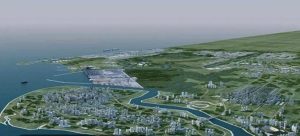
Aerial view of Ibom Deep Seaport location
The recent intervention by Engr. Okon Nkpubre on the Ibom Deep Sea Port controversy deserves respect and thoughtful engagement. As one of the elder statesmen of Oron Nation and a passionate advocate for the original Ibaka Port vision, his concerns are clearly borne out of a deep commitment to the development of his people and Akwa Ibom State.
However, at this critical juncture, it is imperative that all stakeholders rise above positions that may inadvertently delay or endanger one of the most transformational economic projects in our state’s history.
The first point that must be made is that no one is disputing the historical significance of Ibaka in the conception of the Deep Sea Port project. Indeed, available records indicate that Ibaka featured prominently in earlier studies and formed part of the Federal Government’s maritime development vision for Akwa Ibom State. The aspirations of Oron people regarding the project are therefore understandable and deserve recognition.
Yet, infrastructure projects of this magnitude are not static. They evolve. New technical studies emerge. Environmental realities change. Investor expectations become more sophisticated. Economic projections are updated. Consequently, governments and project promoters have a responsibility to continually evaluate available options and adopt the location that offers the greatest possibility of long-term success.
The central issue before Akwa Ibom today is not whether Oron deserves development. It does. The issue is not whether Ibaka possesses maritime advantages. It does. The real question is simple: Which location presently provides the best conditions for establishing a globally competitive deep sea port capable of attracting investment, handling modern shipping demands, and remaining economically sustainable for generations?
This question cannot be answered through emotions, political sentiments, or historical grievances alone. It must be answered through science, engineering, economics, environmental assessments, and professional judgment.
Around the world, ports succeed where nature provides the most favourable conditions for maritime operations. Natural deep-water advantages, navigational safety, reduced maintenance costs, operational efficiency, and investor confidence are all critical considerations in determining port locations.
The objective, therefore, should not be to insist on a particular location merely because it was initially proposed several years ago. Rather, the objective should be to identify the location that can make the Ibom Deep Sea Port succeed in today’s realities and in the decades ahead.
This is not an argument against Oron Nation. Neither is it an attempt to diminish the historical contributions and legitimate concerns of the people of the area. Every stakeholder has a right to ask questions, seek clarifications, and demand transparency. Dialogue remains essential.
However, dialogue must ultimately lead to consensus and progress.
The unfortunate reality is that prolonged disputes over location have already contributed to years of delay. Every year lost represents missed opportunities for employment, industrialisation, revenue generation, and economic expansion. Investors naturally gravitate towards environments where there is certainty, cooperation, and collective commitment to a shared vision. Prolonged public disagreements and persistent controversies create the kind of uncertainty that can discourage investment decisions.
Akwa Ibom cannot afford further delays.
The Ibom Deep Sea Port is much bigger than any individual, ethnic group, or political interest. It is potentially one of the largest economic assets in Nigeria’s maritime sector. It can stimulate industrial clusters, attract manufacturing concerns, expand export opportunities, create thousands of direct and indirect jobs, and position Akwa Ibom as a strategic maritime gateway for West and Central Africa.
These benefits will not belong exclusively to one local government area. They will accrue to the entire state. Oron people will benefit. Ibeno people will benefit. Eket people will benefit. The youths of Akwa Ibom will benefit. Nigeria as a whole will benefit.
Governor Umo Eno’s appeal should therefore be viewed in that broader context. His plea is fundamentally a call for unity, understanding, and cooperation so that the state does not lose another historic opportunity to internal disagreements.
This does not require anyone to abandon deeply held convictions. It simply requires all stakeholders to place the future prosperity of Akwa Ibom above sectional interests and allow technical evidence, professional assessments, and investor considerations to guide final decisions.
At this defining moment, history will not remember who won the argument about location. History will remember whether Akwa Ibom succeeded in building a world-class deep sea port that transformed the fortunes of its people.
Let the conversations continue. Let concerns be addressed respectfully. Let transparency prevail. But above all, let us not permit controversy to bury a project that can redefine the economic destiny of our state.
The dream of the Ibom Deep Sea Port is too important to fail. The responsibility before us all is not to win debates but to ensure that the port takes off and succeeds for the benefit of present and future generations.
Akwa Ibom has waited long enough. The time has come to move from debate to delivery.